



As a musician, it's very likely that you've had to face traveling with your instrument on a plane, and that's when a thousand questions arise... Can you travel with your instrument as carry-on luggage? Can I check my instrument? What happens if my checked musical instrument is damaged? Do I have to buy another seat for my instrument?
Below, we answer all these questions and discuss the conditions of the most common airlines for flying with instruments.
Which instruments should I check and which can I take as carry-on?
When traveling by plane with your instrument, the answer is simple: it depends on the airline. We recommend you read your airline's conditions carefully and even bring a printed copy with you. Unfortunately, airport staff can misinterpret the conditions, and having them on hand helps when complaining or preventing your instrument from being sent to the cargo hold.
There is actually a European Union recommendation but ultimately airlines establish their own rules. We summarize the main ones (you can view the airlines' websites by clicking on their name):
Ryanair: limited carry-on instrument
They allow an instrument as carry-on luggage as long as it does not exceed the permitted size. If it does (as in the case of guitars, violins, or violas, they specify), it can be transported on board if an additional seat is purchased to place it. That is, you can almost only carry a harmonica as carry-on. Everything else has to be paid for or checked in.
Larger instruments than those specified must be checked to travel in the aircraft's hold but with a maximum weight of 20kg. For this, the specific extra must be contracted at the time of booking. If it weighs more than 20kg, the excess weight would have to be paid.
Easyjet: instruments as carry-on luggage
For this company, we appreciate that everything is very specified according to sizes:
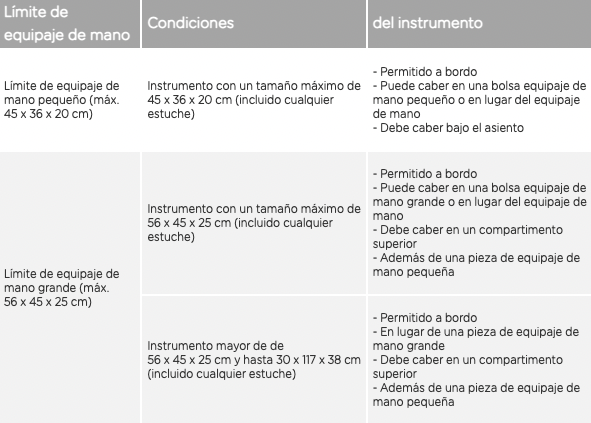
Larger instruments can travel in the cabin, but by purchasing an extra seat for them with the name 'Mr. Musical Instrument' and provided the following conditions are met:
- It must not exceed the maximum permitted weight of 75 kg (instrument and case together)
- It must fit within the minimum seat width of 43 cm
- It must be in a case, with a handle through which the seatbelt can be threaded, so that it can be securely fastened to the seat
- It must not protrude more than 30 cm above the top of the seat back. The seat height is 68 cm from the seat cushion and 114 cm from the floor.
- It can only be placed in window seats
- It cannot be booked for restricted seats (seats in the first or last row and seats at emergency exits) or in rows next to restricted seats
Other larger instruments or those that do not meet the above conditions must travel in the hold and the corresponding checked baggage allowance must be paid.
Wizzair: limited liability if you check in
With this low-cost airline, your musical instrument can be carry-on luggage as long as it does not measure more than 80x40x23 cm. As with other airlines, in this case you will not be able to carry another hand luggage, and it must be placed in the overhead compartment.
If the instrument is larger than the mentioned dimensions, it must travel in an extra seat to be paid separately.
And finally, this company states that if the instrument is larger than a cello, it must travel in the hold; but be careful in this case because they indicate that only if it is labeled with "limited liability":
The carriage of damaged, fragile, bulky, improperly packed, oversized, and late-checked baggage will only be accepted if it carries the limited liability baggage tag. Wizz Air cannot accept responsibility for such items.
Iberia and Iberia Express
The Spanish airline allows you to carry your instrument as hand luggage without buying an additional seat, as long as it does not exceed these dimensions: 30x120x38 cm. This is one of the most permissive policies we have seen, although no more hand luggage pieces will be allowed.
If it is a larger instrument, it can be transported in an additional seat, but you must contact customer service to find out if it is possible and under what conditions, or directly check it as long as it does not exceed 190x75x65cm, with a maximum weight of 23 kg.
Vueling: instrument as special baggage
This company has been involved in many incidents with musicians... But beyond that, we summarize their brief conditions. Not specifying much is probably what causes the problems:
Musical instruments are considered "special baggage," and must be checked. But they allow the option to reserve an extra seat to carry it in the cabin, although we do not know what minimum/maximum size is allowed for that extra seat...
It is specified that nothing over 32kg or 270cm can be checked in the hold.
Air Europa
It specifies that musical instruments can be hand luggage as long as they do not exceed 115cm and 10kg when summing all sides of the case (for curved cases, this is quite difficult to get exact...). If the aircraft operating the flight is an ATR, the conditions are somewhat more restrictive: the maximum weight drops to 8kg and the dimensions to 55cm x 35cm x 20cm.
If our instrument exceeds 115cm, then it must travel in the hold or pay for an extra seat if we wish for it to accompany us in the cabin. Its weight will not exceed 75kg and it must be able to be secured to the seat in such a way that the rear seat can recline without problems.
Air France
Instruments (always in a case and with rounded corners) measuring less than 115 cm when adding height, width, and depth are considered hand luggage. However, no other hand luggage pieces can then be transported.
For instruments (always in a case and with rounded corners) measuring more than 115cm, you must contact customer service and pay to reserve an extra seat if you wish to transport it in the cabin, and only if it weighs less than 45kg.
The French airline specifies that instruments measuring less than 158 cm when summing their sides, must be checked in the hold. The maximum weight will be 23 kg (Economy or Premium Economy fares) or 32 kg (for Business or La Première fares).
On the other hand, instruments weighing more than 32 kg or measuring more than 300 cm could be checked, but always with prior authorization, by writing to customer service at least 48 hours before the flight.
Eurowings
With Eurowings, to travel by plane with your instrument, you should know that they allow instruments in soft cases within the dimensions of 55 x 40 x 23 cm. Larger ones, must travel in an extra seat (they can be in a soft case) and they specifically require double basses to be checked. Both this last instrument and others, if checked, must then travel in a hard case.
Checked musical instruments: they are also luggage
What happens if there's no choice but to check the instrument? Musical instruments are included within what is considered luggage, so if you are forced to check it, it is subject to the Montreal Convention, which allows you to claim liability from the airline in case of problems.
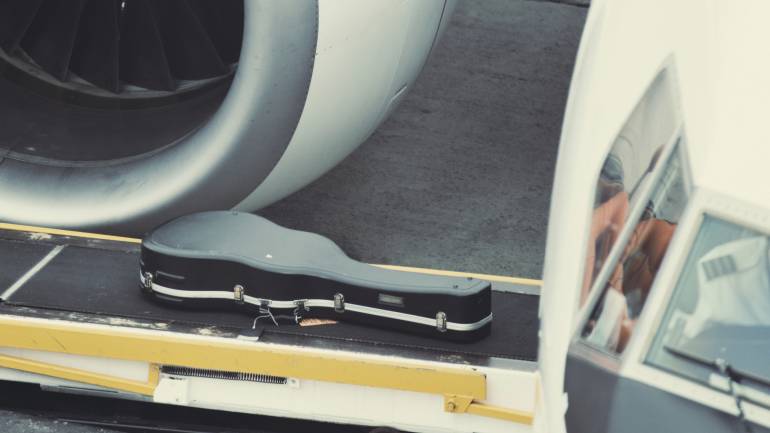
In general terms, we give you some basic tips for possible unpleasant situations:
- Protect your instrument well in an appropriate case and remove accessories or secure them well. If your instrument is a string instrument, detune the strings a little.
- Place some "Fragile" stickers if possible, they are never too much.
- If your instrument is damaged or the case, go to the airline counter as soon as possible and request a claim (called a PIR), keeping a copy.
- If it is an expensive instrument, it is advisable to make a declaration of value.
- Keep all documentation (tickets, check-in receipt, etc.) in case you need to file a claim: it is essential.
Conclusions for traveling by plane with your instrument
No matter what, carefully store your instrument in an appropriate case or gig bag and, above all, a rigid one.
Read your company's conditions very carefully and be prepared in case you ultimately have no choice but to check your luggage.
In any case, we hope that airlines will become more aware that an instrument is a valuable working tool that should be transported easily and without causing us headaches.
Have you ever had an undesirable situation when transporting your instrument?

